


AI is everywhere right now.
Every software company has added an AI button. Every second LinkedIn post is about agents replacing entire teams. And apparently, if your business hasn't automated half its operations by Tuesday, you're already falling behind.
It's a bit much.
I work with businesses on AI, HubSpot and Revenue Operations, and one of the biggest problems I see isn't a lack of technology.
It's knowing where to start.
Because there's a fairly significant difference between using AI and making AI genuinely useful to your business.
For businesses here in Wollongong and across the Illawarra, the opportunity isn't necessarily to build something revolutionary.
It might just be to make the systems and processes you already have work a hell of a lot better.
So where should you actually begin?
Start with the work, not the tool. Identify a repetitive or frustrating business process, understand why it happens, and test whether AI can improve it without introducing unnecessary cost, complexity or risk.
That's AI enablement in its simplest form.
And you probably don't need another six subscriptions to get started.
First, what does AI enablement actually mean?
AI enablement is the process of identifying where artificial intelligence can help your business, preparing your people and systems to use it, and implementing practical solutions that deliver a measurable benefit.
That sounds fairly corporate, so let's simplify it.
It's working out:
What your team spends too much time doing.
Where information gets lost or duplicated.
Which processes involve repetitive administration.
What decisions could be improved with better information.
Whether AI can actually help with any of those things.
And then doing something useful about it.
Sometimes that means introducing a tool like ChatGPT or Claude.
Sometimes it means using AI features already available in HubSpot, Microsoft 365 or another platform you're paying for.
Sometimes it means combining existing software with a fairly straightforward automation.
And sometimes the best recommendation is not to use AI at all.
That's an important part of the job too.
The biggest mistake: starting with the AI tool
Here's a scenario.
A business owner hears that AI agents can autonomously follow up sales leads.
Sounds great.
They find a platform, connect their CRM, build some automated messages and start sending them.
Except nobody has properly defined what a qualified lead is.
Their contact database is messy.
Sales and marketing disagree about who owns the follow-up.
And half the enquiries coming through the website aren't being recorded correctly anyway.
Congratulations. You've now automated a broken process.
Only faster.
This is why I keep coming back to RevOps and customer journey mapping when talking about AI.
Before introducing something new, understand how the business currently operates.
If you don't know where the problems are, adding automation might make them harder to identify.
I've covered this broader systems problem in my article on why RevOps matters for Wollongong and Illawarra businesses.
The same principle applies here.
Technology should support the process, not dictate it.
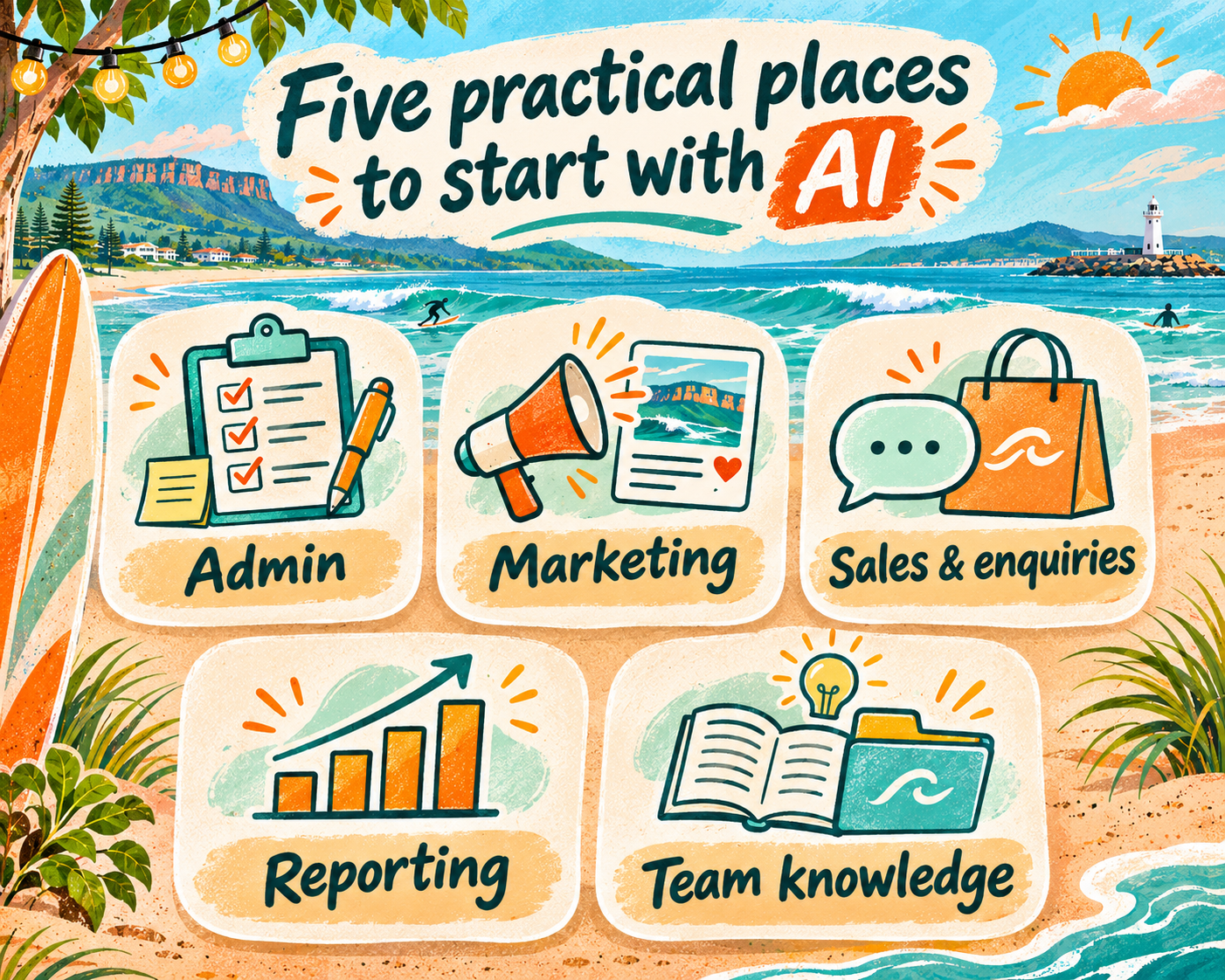
Five practical places to start using AI in your business
You don't need to reinvent your entire operation.
For most small and medium businesses, I'd start by looking at five fairly ordinary opportunities.
1. Repetitive administration
Think about the tasks your team completes every day that don't require much original thinking but still consume a surprising amount of time.
Things like:
Summarising meetings and identifying action items.
Preparing first drafts of proposals or reports.
Reformatting information between documents.
Creating standard operating procedures.
Categorising incoming enquiries.
Preparing follow-up emails for review.
These are often excellent starting points because the work is reasonably predictable and the output can be checked.
Take a recurring meeting, for example.
Instead of somebody spending half an hour turning their notes into an update, an approved AI tool could prepare the summary, identify decisions and draft the follow-up tasks.
A person still reviews the result.
But the administrative part becomes considerably easier.
The goal isn't to eliminate human involvement. It's to make that involvement more valuable.
2. Marketing and content production
This is probably where many businesses have already experimented with AI.
Writing social posts. Brainstorming campaigns. Drafting emails. Creating images.
All useful.
But there's a big difference between asking AI to write ten social posts and giving it enough context to produce ten posts that actually reflect your business.
A better approach is to provide:
Your target audience and their problems.
Your brand voice and examples of existing writing.
The purpose of the content.
Your actual products, services and offers.
The next action you want someone to take.
Then review, refine and publish.
AI can help with the production process without needing to replace the strategy, personality or expertise behind it.
And ideally, your audience shouldn't feel like they're reading something copied straight out of a chatbot.
There's enough of that already.
3. Sales and customer enquiries
Let's say you're a growing service business in Wollongong.
Enquiries arrive through your website, emails, referrals and social media.
Some need an immediate response. Others need more information before anybody can quote or follow them up.
AI might help categorise enquiries, prepare relevant responses, summarise conversations or identify missing information.
But there's a catch.
AI needs to understand what a good enquiry actually looks like for your business.
Without that context, it might confidently prioritise the wrong opportunities.
This is why lead qualification, CRM structure and customer journey mapping are so closely connected to practical AI adoption.
The better your processes and information, the more useful AI can become.
And if you're already using HubSpot, it's worth understanding which existing features can support the process before adding another platform.
4. Reporting and business information
One of my favourite opportunities for AI isn't generating content.
It's helping people understand information they already have.
Businesses collect an enormous amount of data.
Sales activity. Customer enquiries. Website traffic. Campaign results. Project performance. Financial reports.
But having the data doesn't automatically mean anybody knows what to do with it.
AI can help identify patterns, summarise reports, highlight inconsistencies and suggest questions worth investigating.
For example:
Our enquiries have increased this quarter, but sales haven't. What should we investigate?
That's a more useful starting question than:
Build me an AI dashboard.
Of course, the underlying data still needs to be accurate, and any calculations or conclusions should be verified.
AI can help interpret information.
It shouldn't be given permission to invent the numbers.
5. Internal knowledge and team support
This is one I think more businesses should explore.
How often does somebody ask:
Where's that document?
What's the process for this?
Who approved that decision?
How did we do this last time?
The answers might be scattered across shared drives, emails, internal documents and the heads of three different people.
With the right permissions and controls, AI can help staff find and summarise approved internal information more efficiently.
That doesn't mean giving a chatbot unrestricted access to every file in the business.
It means building a useful, controlled way for people to access information they're already authorised to use.
The opportunity is reducing the time spent hunting for answers.
Not creating another system nobody knows how to maintain.
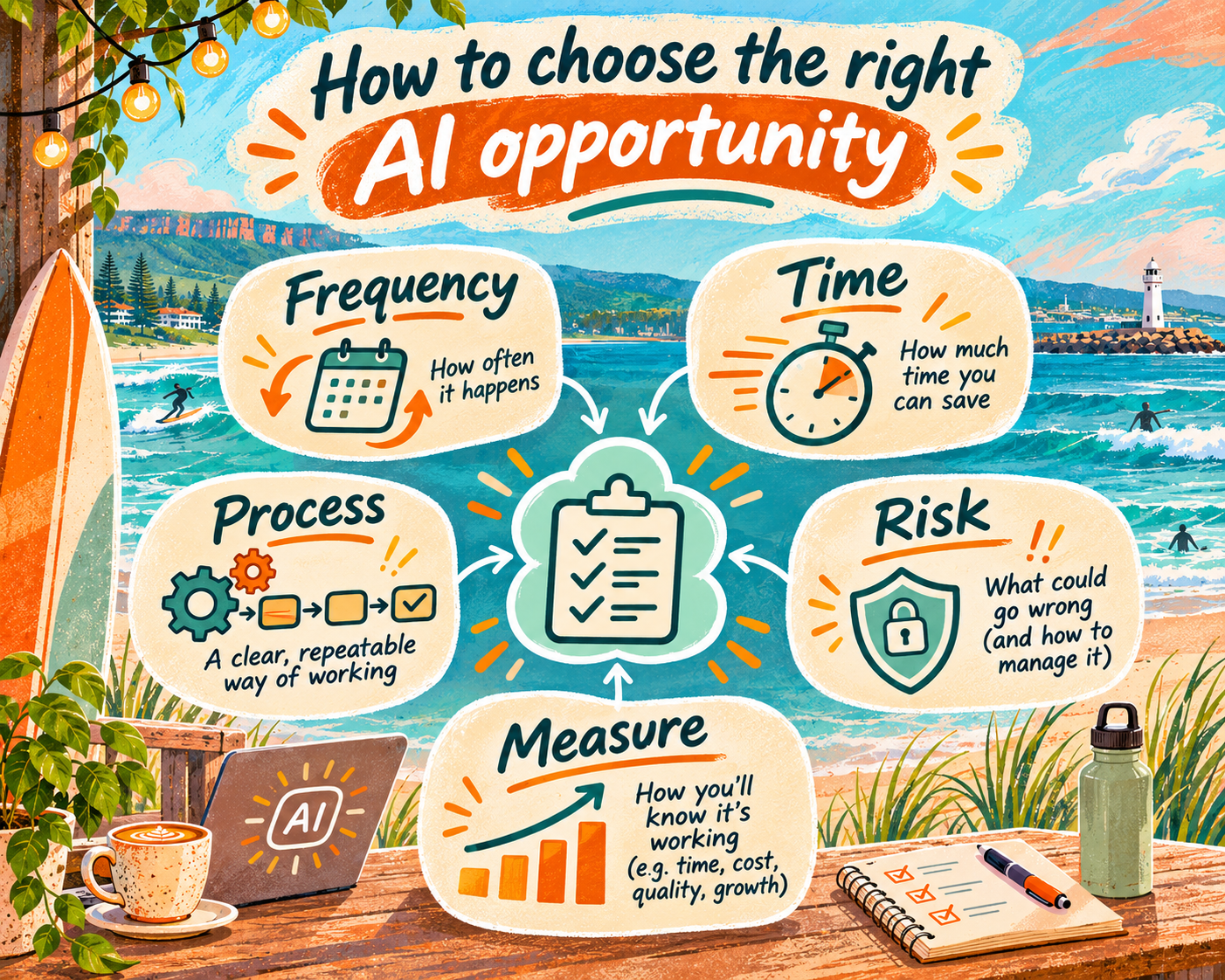
How do you choose the right AI opportunity?
Here's the simple assessment I'd use.
Before introducing an AI tool, look at a potential use case through five questions.
1. How frequently does the problem occur?
A task that happens twenty times a week might be worth more attention than something that happens twice a year.
2. How much time or effort does it consume?
Is it genuinely slowing people down, or is it just a little annoying?
3. Is the process understood and reasonably consistent?
If nobody agrees how the work should happen, clarify that before automating it.
4. How much risk is involved?
Drafting a generic internal document is very different from making decisions about customer finances, employment or sensitive personal information.
5. Can we measure whether the change helped?
If you can't describe what success looks like, you'll struggle to know whether the investment was worthwhile.
I'd generally start with opportunities that are frequent, repetitive, easy to review and relatively low risk.
Then build confidence from there.
Not every opportunity needs an AI agent.
Sometimes a good prompt, an approved tool and a documented process are enough.
Before you plug everything into AI, think about your data
This is the part that tends to receive considerably less attention than the exciting demos.
What information are you giving the AI?
Where does it go?
Who can access it?
Can the output be trusted?
And what happens if it gets something wrong?
If you're using AI to work with customer records, employee information, financial data or internal company documents, those questions matter.
The Office of the Australian Information Commissioner recommends that organisations avoid entering personal information, particularly sensitive information, into publicly available generative AI tools as a matter of best practice.
That doesn't mean businesses can't use AI with their own systems.
It means the tool, access model, privacy settings and intended purpose need to be assessed properly before sensitive information is involved.
For a smaller business, I'd establish a few practical rules:
Agree which AI tools the team can use.
Define what information can and cannot be shared.
Keep human review for important outputs and decisions.
Make someone responsible for each AI use case.
Test the solution before relying on it.
Regularly check whether it's still working as intended.
You don't necessarily need a forty-page AI policy.
But 'everyone just uses whatever they want' probably isn't a particularly good strategy either.
The Australian Government's Guidance for AI Adoption is a useful starting point for understanding responsible AI governance without turning the whole exercise into an enormous compliance project.
A practical 30-day AI starting plan
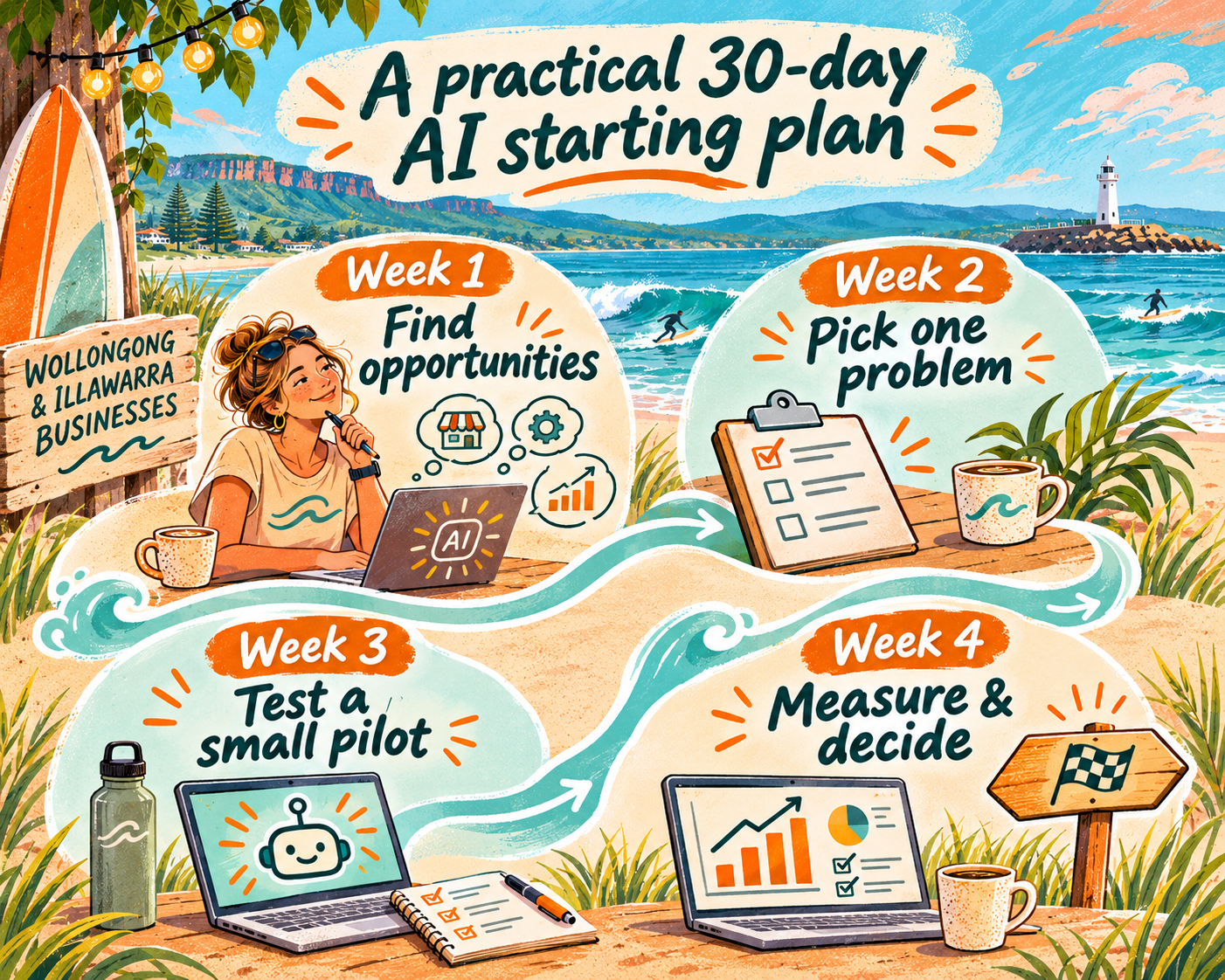
If I were helping an Illawarra business get started with AI, I'd keep the first month deliberately simple.
Week 1: Find the opportunities
Speak to the people actually doing the work.
Ask what takes too long, gets repeated, creates frustration or involves unnecessary copying of information.
Document five to ten opportunities.
Don't choose a platform yet.
Week 2: Choose one useful problem
Assess the opportunities based on frequency, business impact, complexity and risk.
Pick one with a clear outcome and relatively low implementation effort.
Write down how the work happens today.
Decide what improvement would actually count as success.
Week 3: Test a small solution
Use an approved tool and non-sensitive or appropriately controlled information.
Build a small pilot.
Test it against real examples where permitted, including things it might get wrong.
Keep a human involved in checking the results.
You don't need to roll it out across the whole business.
Week 4: Measure and decide
Look at what happened.
Did the task become quicker?
Was the output accurate enough?
Did the team actually find it useful?
Did it introduce additional work or risks?
Was the saving worth the software and implementation cost?
Then make a decision.
Keep it. Improve it. Expand it.
Or abandon it and try something else.
That's not a failed AI strategy.
That's a sensible way of testing technology.
What about building AI agents?
AI agents are interesting because they can go beyond producing an answer and, depending on their configuration and permissions, carry out actions across connected systems.
That might involve researching information, updating records, creating tasks or moving work through a process.
Which is potentially very useful.
It's also where governance, data quality and process design become considerably more important.
An AI assistant making a poor suggestion is one thing.
An agent automatically making the wrong change to a thousand CRM records is another.
I spend a lot of time working around CRM architecture, permissions, lifecycle definitions and automation because these foundations matter when AI begins interacting with business systems.
My preference is to build capability gradually.
Start with AI helping someone do the work. Move towards AI performing actions only when the process is understood, controlled and tested.
Not because autonomous systems aren't exciting.
Because unwinding a bad automated decision is generally less exciting.
Do Wollongong businesses need an AI consultant?
Not necessarily.
And certainly not for every little AI experiment.
If you're a sole trader wanting help with marketing copy, meeting notes or everyday research, you may be able to get a lot of value out of tools you already use.
But external help becomes more useful when:
You're not sure where AI would create a genuine business benefit.
Multiple teams or systems need to work together.
Your customer information is involved.
You need to assess risks, permissions or governance.
You're considering AI agents or more complex automation.
You've experimented with different tools but haven't achieved much beyond interesting demonstrations.
You need someone to translate ideas into an actual implementation plan.
For businesses in Wollongong, Shellharbour and across the Illawarra, that might mean a practical workshop, an AI opportunity assessment or a small implementation project.
Not necessarily a giant transformation program.
I'm based in the Illawarra, but I work with businesses across Australia.
And because gabatwa is deliberately a solo consultancy, you work directly with me throughout the process.
No unnecessary layers.
No AI strategy for the sake of having an AI strategy.
Just a clear understanding of the problem, what might help and how to make it work.
The best place to start with AI is probably something boring
That might be the least exciting conclusion to an article about artificial intelligence.
But it's probably the most useful.
You don't have to start with an autonomous agent.
You don't need an enormous technology budget.
And you definitely don't need to automate everything your business does.
Find something that wastes time.
Understand the process.
Test whether AI improves it.
Measure the result.
Then work out what comes next.
AI should make your business easier to run. Not give everybody another complicated system to manage.
And if the right answer turns out to be fixing the existing process instead?
That's a win too.
Want to work out where AI could actually help your business?
If you're running a business in Wollongong, the Illawarra or anywhere in Australia and you're not sure where to start, let's have a conversation.
We can look at your existing processes, identify some realistic AI opportunities and work out whether there's anything worth implementing.
You don't need to have an AI strategy or a perfectly formed idea before getting in touch.
Straight up conversation. No pressure.
FAQ: AI for small businesses in Wollongong
-
Start by identifying a frequent, repetitive business task that takes unnecessary time. Choose a relatively low-risk use case, test an appropriate AI tool, keep human review in place and measure whether the change provides a genuine benefit.
-
AI enablement involves identifying practical opportunities to use artificial intelligence, preparing the necessary processes and information, training staff and implementing solutions that improve business outcomes.
-
Costs vary depending on the tools, integrations, training and complexity involved. A simple pilot using an approved existing software feature may need little additional spending, while a solution involving multiple systems, custom automation or sensitive information can require significantly more investment.
-
Yes. AI can support CRM-related activities such as summarising records, analysing information, drafting follow-ups and assisting with workflows, depending on the platform's available capabilities and permissions. Data quality, access controls and review processes should be considered before allowing AI to modify records.
-
It depends on the tool, the type of information, how it is processed and the safeguards in place. Businesses should assess privacy obligations, vendor data practices, permissions, security settings and human oversight before using AI with personal or confidential information.
-
Not always. Many everyday AI tasks can be tested internally. An AI consultant becomes more useful when you need help identifying opportunities, integrating systems, improving processes, managing risks or implementing more complex solutions.