


RevOps sounds more complicated than it is.
It isn't another piece of software. It isn't a fancy job title you suddenly need to hire for. And it definitely isn't an excuse to build another dashboard nobody looks at.
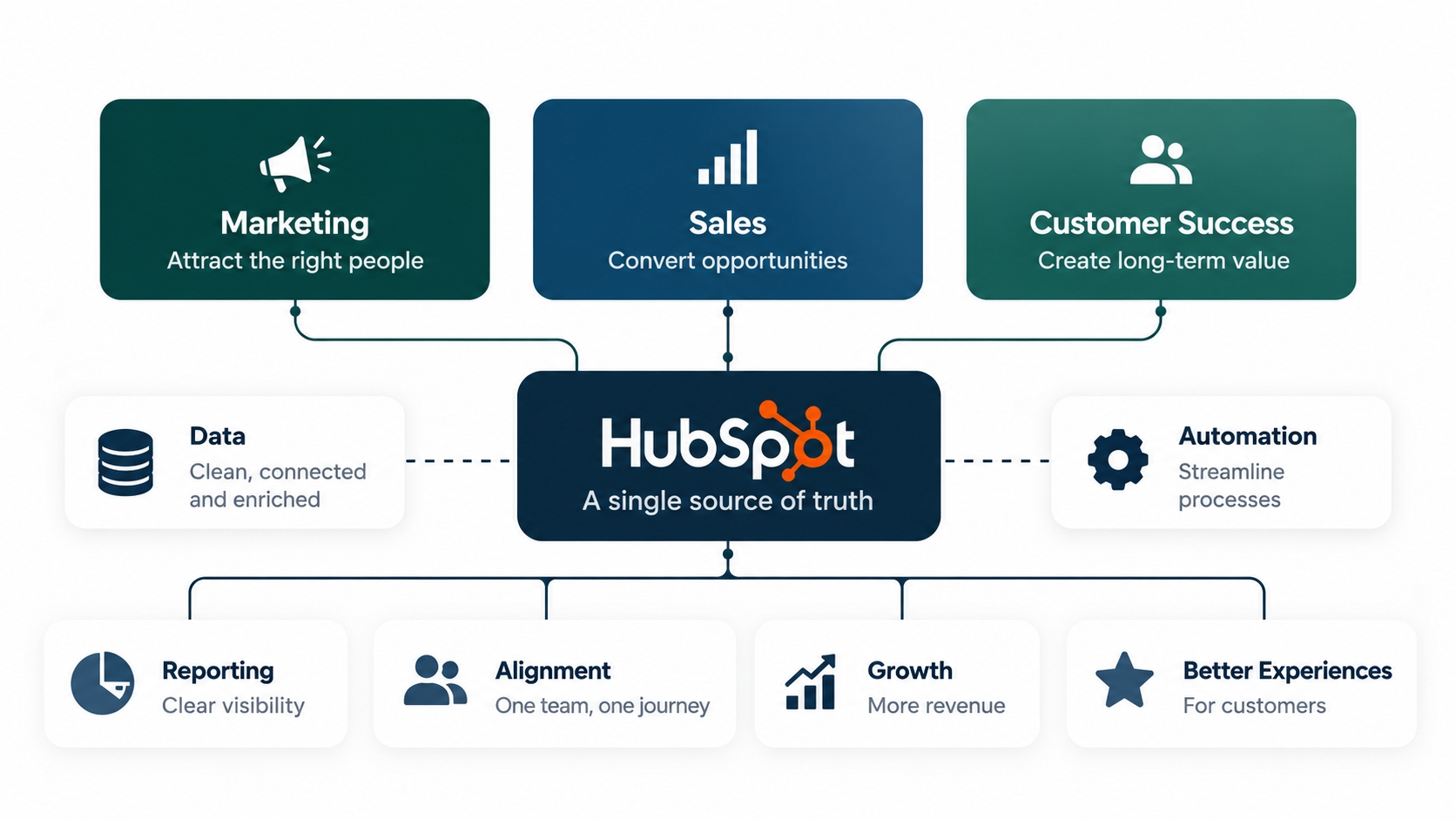
Revenue Operations — RevOps — is basically about making sure the parts of your business responsible for attracting, converting and keeping customers actually work together.
Marketing. Sales. Customer service. Your CRM. Your data. Your reporting. Your automations.
Same customer. Same business. Same goal.
So it makes very little sense for all of those things to operate like separate islands.
That matters anywhere. But I think it's becoming particularly relevant for businesses here in Wollongong and across the Illawarra.
What is RevOps, in plain English?
If someone asked me what a RevOps consultant actually does, I'd explain it like this:
I look at how someone becomes a customer, what your team and technology do along the way, and where things are unnecessarily difficult, disconnected or invisible, then we fix it.
Maybe marketing is generating leads, but sales doesn't know which ones matter.
Maybe sales has its own spreadsheet because nobody trusts HubSpot.
Maybe HubSpot is full of useful information, but management still builds reports manually every month.
Maybe you've got five different systems doing jobs that one could handle.
Maybe an enquiry comes through your website and everyone assumes somebody else followed it up.
None of those problems are really “marketing problems” or “sales problems”.
They're systems problems.
That's the territory RevOps sits in.
Why does RevOps matter in the Illawarra?
Because the Illawarra business community is changing.
Wollongong City Council's current economic strategy is targeting 20,500 additional net jobs by 2035, while the broader regional economy now spans advanced manufacturing, ICT, professional services, creative industries, clean energy and plenty more alongside its traditional industrial base.
There's also a very real technology and startup ecosystem here. UOW's iAccelerate says it supported 86 startups and scaleups during 2025, with its resident companies contributing $24.8 million to the regional economy that year.
That's good news.
But growth creates operational pressure.
More customers. More staff. More leads. More channels. More software. More reporting. More handovers between people.
And eventually the processes that worked when everything could be kept in someone's head stop working.
That's where the cracks appear.
Wollongong City Council's own business research has previously put use of technology within the business among the areas local businesses wanted to strengthen, alongside things like business development, marketing and business planning.
To me, those things aren't separate.
Technology should support the business plan. Marketing should feed the sales process. Sales activity should create useful customer data. That data should make reporting easier. And AI should make the whole thing lighter rather than introducing another six subscriptions.
That's RevOps.
You probably don't have a software problem
This is something I see a lot with HubSpot.
A business buys the platform for a perfectly sensible reason.
Then time passes.
Someone adds a workflow.
Another person creates some properties.
A new sales process gets introduced but HubSpot never quite gets updated to match it.
An integration gets connected.
Someone else creates a dashboard.
There are duplicate fields.
Nobody is entirely sure why one lifecycle stage works the way it does.
And eventually somebody asks:
“Are we actually getting enough value out of HubSpot?”
That's usually the right question.
Not:
“What should we buy next?”
When I originally shared my Strategic HubSpot Audit framework, it was built specifically for businesses that had already been using HubSpot for 12 months or more and had reached that point where something simply felt off.
The common signs were fairly straightforward:
The data isn't giving you what you need.
Reporting feels harder than it should.
Parts of HubSpot you're paying for aren't being used.
The CRM doesn't quite match how the business actually operates.
You're paying for Professional or above but aren't sure you're getting Professional-level value.
The important part is that this isn't really a technical audit.
It's a business-alignment audit.
The question isn't whether every setting in HubSpot follows some theoretical best practice.
The question is:
Is HubSpot actually helping this business do what it is trying to do?
That's a much more useful place to start. The original framework I shared on LinkedIn was deliberately designed around that idea: use the context of the business first, then use AI to help assess whether the CRM supports it.
Want to try it yourself?
I've made my DIY AI-Powered Strategic HubSpot Audit Guide available so you can work through that process yourself.
No generic 100-point checklist.
The idea is to give AI tools like ChatGPT or Claude enough context about your goals, processes and existing HubSpot setup to help identify what actually needs attention.
Where AI fits into RevOps
This is also where AI starts becoming genuinely useful.
Not because every business suddenly needs an “AI strategy”.
And not because everything needs an agent.
Sometimes AI is just a much faster way of doing work that was previously tedious.
For example, instead of staring at a messy CRM and trying to work out where to begin, you can give an AI model:
your business goals;
your sales process;
your customer journey;
your current reporting requirements;
screenshots or recordings of the CRM;
process documentation;
exports of relevant properties or workflows.
Then ask better questions.
Where doesn't the CRM reflect the sales process?
What information are we collecting but not using?
Where are leads likely to be getting stuck?
Which workflows duplicate one another?
What information would management need to make a better decision?
Suddenly AI isn't some abstract innovation project.
It's helping you understand your own business.
That's the kind of AI enablement I'm interested in.
Use it where it makes something easier, faster or more useful.
Leave it alone where it doesn't.
Business Illawarra has made a similar broader point around AI: the technology is already changing how businesses operate, and the opportunity for the region is to learn how to use it productively rather than treat it as some distant future event.
A simple RevOps check for your business
You don't need to launch a six-month “Revenue Operations Transformation Initiative”.
Please don't.
Take an hour and answer these questions instead.
1. How does someone actually become a customer?
Write the real journey down.
Not the journey you think happens.
Where do they find you? What happens next? Who follows them up? Where is that recorded?
2. Who owns each step?
If the answer is “usually Sarah” or “I think sales handles that”, there's probably work to do.
Every important handoff should have a clear owner.
3. Does your CRM reflect that journey?
Your CRM shouldn't force your team into a process that only makes sense inside the CRM.
The technology should reflect how your business works.
4. Can you trust the data?
Can you confidently answer basic questions such as:
Where are our best leads coming from?
How many genuine opportunities do we have?
How long does it take someone to become a customer?
Why are we losing deals?
Which marketing is contributing to revenue?
Which customers are becoming repeat customers?
If answering those requires combining three spreadsheets every month, there's an opportunity.
5. What are people doing manually?
Copying information between systems.
Sending the same follow-up emails.
Building repetitive reports.
Creating tasks.
Assigning leads.
Cleaning lists.
These are usually better places to start with automation and AI than trying to build an all-knowing robot employee on day one.
6. What are you paying for that you aren't using?
This is a big one.
Before adding another platform, integration or subscription, work out what the tools you already own can actually do.
Often the cheapest new piece of software is no new software at all.
Do small and medium Illawarra businesses actually need RevOps?
Not necessarily as a department.
That's an important distinction.
A growing Wollongong business doesn't suddenly need a VP of Revenue Operations, three analysts and an operations team.
But it probably does need somebody thinking about revenue operations.
For a smaller organisation that might simply mean periodically stepping out of the day-to-day and looking across marketing, sales, customer service, CRM and reporting as one connected system.
Fix the obvious gaps.
Automate sensible things.
Remove duplicated tools.
Give people clearer ownership.
Make the reporting trustworthy.
Then get back to running the business.
That's enough.
RevOps, HubSpot support or AI enablement, which one do you actually need?
Another simple way to think about it:
You probably need HubSpot support if…
You know what the process should be, but HubSpot needs to be audited, cleaned up, implemented or configured properly.
You probably need RevOps help if…
The problem crosses teams.
Marketing, sales, customer service, processes, data and technology aren't quite joining up, and it's not obvious which part should be fixed first.
You probably need AI enablement if…
You understand the process but want to work out where AI or automation could remove manual work, improve decisions or help your team work faster.
And sometimes it's all three.
That's fine too.
The important thing is starting with the problem rather than starting with the software.
What does a RevOps consultant in Wollongong actually help with?
Practically, my RevOps work can include things like:
mapping the customer journey;
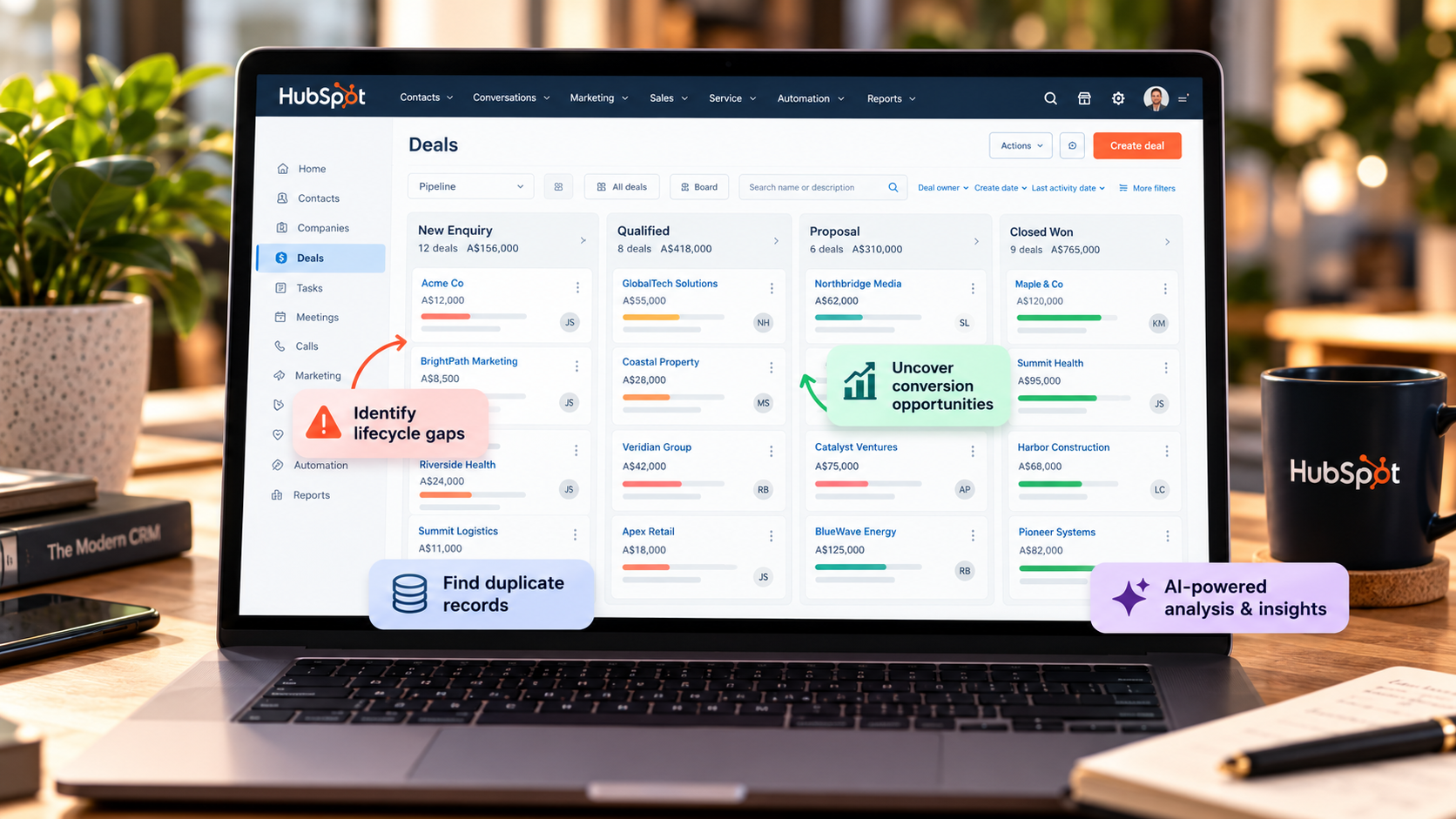
fixing lifecycle stages;
improving lead handoffs;
defining CRM architecture;
cleaning up data;
improving HubSpot;
aligning sales and marketing processes;
building reporting people can actually understand;
reviewing integrations;
reducing unnecessary tools;
finding sensible automation opportunities;
using AI to speed up operational work;
creating a roadmap for what gets fixed first.
Sometimes that turns into a larger project.
Sometimes we spend an hour together, identify the three things actually causing the problem, and you go fix them.
Both are valid.
I'm based here in the Illawarra, but I work with organisations across Australia.
And because gabatwa is deliberately a solo consultancy, you deal directly with me.
No account manager.
No giant project team.
No three weeks of meetings before anybody touches anything.
That's also central to how the site and consultancy are positioned in your brief: direct 1:1 involvement, realistic budgets and the ability to move from figuring out the problem to actually implementing the fix.
Your systems should make the business easier to run
That's ultimately the point.
RevOps isn't about having the perfect CRM.
It's not about automating everything.
And it's definitely not about collecting as much software as possible.
It's about creating enough structure that your people can spend less time fighting the systems around them and more time doing useful work.
For businesses across Wollongong and the Illawarra, particularly those starting to grow beyond the processes they built in their early days, that's becoming increasingly important.
You might already have the technology you need.
You may simply need to make it work properly.
Already using HubSpot?
Start with my free DIY AI-Powered Strategic HubSpot Audit Guide and see where the gaps are.
Or, if you'd rather talk through what's going on:
Straight up conversation. No pressure.
FAQ: RevOps in Wollongong and the Illawarra
-
Revenue Operations, or RevOps, is the practice of aligning marketing, sales, customer service, data, technology and reporting around the way a business generates and retains revenue. The aim is to remove friction between teams and create clearer, more reliable processes.
-
A small business usually doesn't need a dedicated RevOps department. It can still benefit from RevOps thinking, particularly when leads, customer data, sales processes, marketing systems and reporting have become disconnected as the business has grown.
-
Yes. HubSpot is often one part of the broader revenue system. A RevOps consultant can look beyond the technical HubSpot configuration to determine whether the CRM properly supports the business's marketing, sales, customer service and reporting requirements.
-
A good trigger is when you've been using HubSpot for a year or more and are beginning to question the value you're receiving from it, particularly if reporting is difficult, data can't be trusted, features are going unused or your real processes no longer match the CRM setup. This is exactly the use case behind my DIY Strategic HubSpot Audit framework.
-
Yes. AI can help analyse your business context, CRM documentation, processes and portal setup to identify gaps and prioritise areas for review. It works best when it's given information about the actual business rather than being asked to assess HubSpot against generic best-practice rules.